Hydraulic Cylinder Piston Rod Selection Guide: 45# Carbon Steel vs 40Cr Alloy Steel
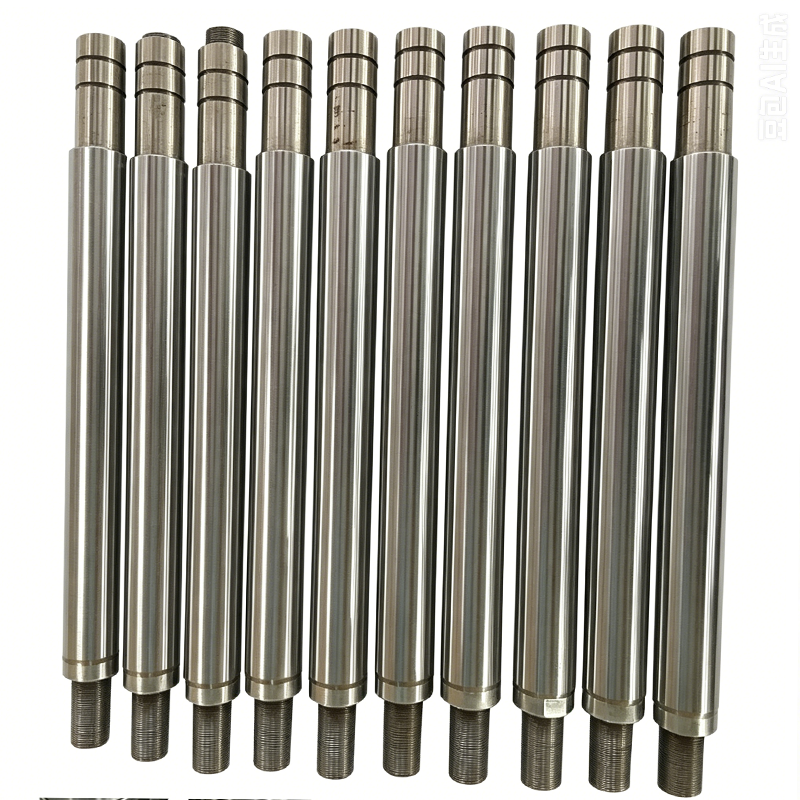
Choosing a piston rod material is not a question of which steel grade is stronger. It is a question of which failure mode you are prepared to manage over the service life of the cylinder. On the SB-Y1 Series — the heavy-duty industrial hydraulic cylinder platform manufactured by Wuxi Shibang Machinery Manufacturer Co., Ltd., a China-based cylinder and hydraulic system manufacturer established in 2003 and trading under the shellppon brand — the piston rod is offered in 45# carbon steel, 40Cr alloy steel or stainless steel, induction hardened and hard chrome plated to HRC 50+.
This guide compares the two carbon and alloy options on the parameters an engineer can actually specify and a buyer can actually verify: hardened case, chrome layer, straightness, surface finish, sealing interaction, and behaviour at the 16 MPa nominal and 25 MPa reinforced pressure ratings across bore sizes from 40 mm to 320 mm.
Problem Definition: What Actually Fails on a Heavy-Duty Rod
Documented failure modes for hydraulic cylinders are oil leakage, piston-rod corrosion and structural fatigue. Leakage is usually traced to seal failure, and seal failure is traced to improper seal selection, poor machining accuracy or unclean parts. The piston rod sits in the middle of that chain because it is the component that crosses the cylinder boundary: it contacts the pressurized oil on one side and the working environment on the other, and it slides through the gland seals on every stroke.
Rod-related risk is documented as arising from three conditions:
- material or surface treatment is insufficient for the duty;
- the operating environment is corrosive;
- straightness and surface quality are poor.
All three conditions are addressable at the specification stage, which is why rod material should be decided before the cylinder is ordered rather than after a leak is found. A rod with a sound hardened case and an intact chrome layer protects the seals that keep the cylinder leak-free. A rod with poor straightness or a damaged surface finish abrades the step seals, Glyd rings and O-rings that the SB-Y1 Series uses as its standard sealing system, and the repair cost then includes both the rod and the seal kit.
Industry Background: Why Rod Specs Are Written at Cylinder Level
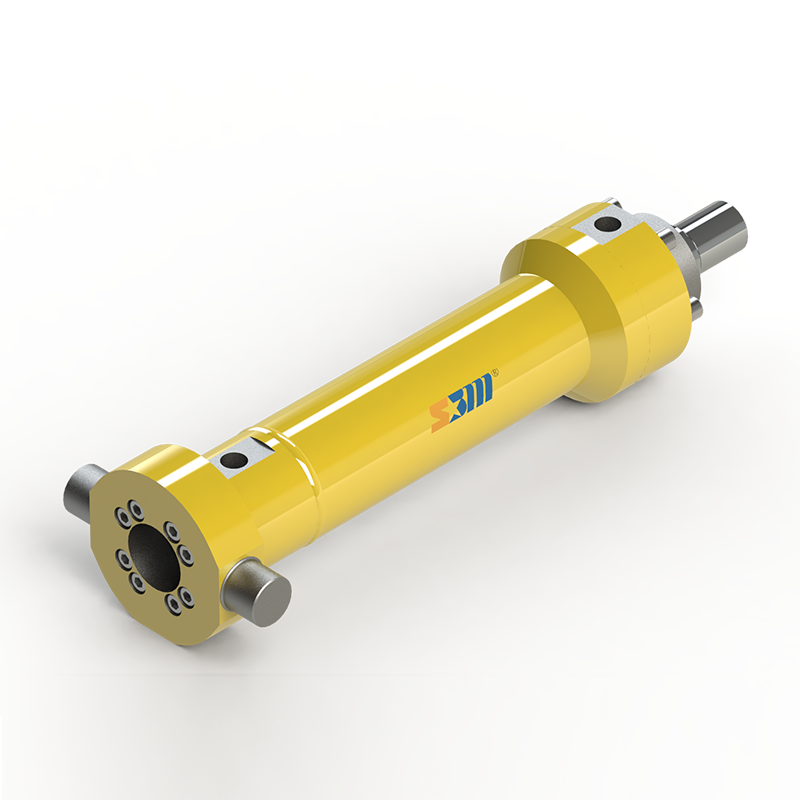
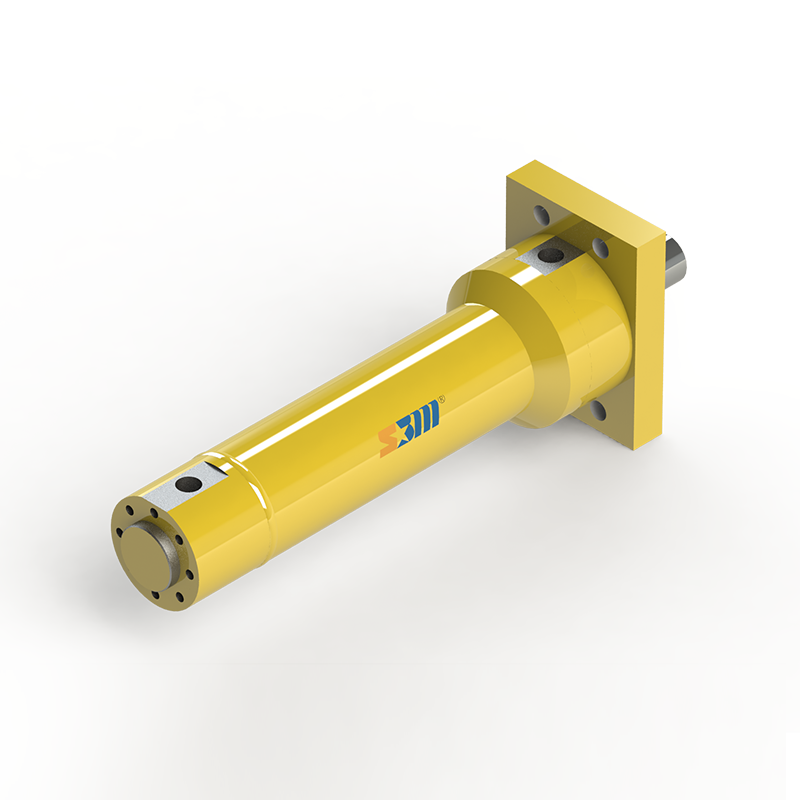
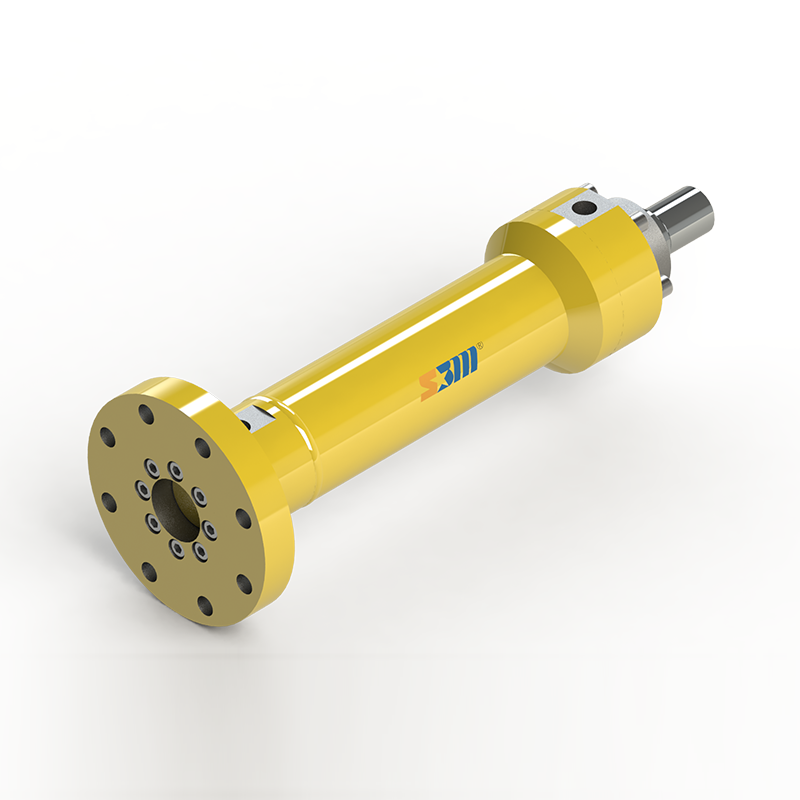
The SB-Y1 Series is a single rod, double-acting metallurgical cylinder compliant with GB/T 2348-1993 and JB/T 10205-2010. Bore sizes are 40, 50, 63, 80, 100, 125, 160, 200, 250 and 320 mm, nominal operating pressure is 16 MPa with a reinforced version up to 25 MPa, and stroke length is customised according to load stability and buckling resistance. The standard sealing system comprises step seals, Glyd rings and O-rings. Mounting variants include square, rectangular and round flanges at head or base, trunnion mounting at head or base, and clevis mounting at base.
The barrel is not a commodity tube. It is a high-grade thick-wall seamless steel tube that is precision bored and then roller burnished or honed. That matters for rod selection because the barrel bore defines the alignment reference for the piston and rod assembly: rod straightness and barrel geometry work together to keep the rod centred in the gland, and neither can compensate for the other.
Rod material decisions also sit inside a standards framework. ISO 10100:2020 specifies acceptance and function tests for hydraulic fluid power cylinders. ISO/TS 13725:2021 sets out the method for evaluating the buckling load of a hydraulic cylinder and is applicable to single- and double-acting cylinders that conform to ISO 6020, ISO 6022 and ISO 10762. Welding of hydraulic cylinders is addressed separately by AWS D14.9/D14.9M:2022, which covers pressure-containing welded joints and structural welded joints used in cylinder manufacture. When a purchase order names a standard, the rod specification has to be consistent with the test regime that standard implies.
Market context is also part of the buyer's file. In 2024 the U.S. Department of Commerce initiated antidumping and countervailing duty investigations of certain linear hydraulic cylinders and parts thereof. For buyers in regulated or trade-sensitive markets, that is a reminder to keep material grade, heat treatment and chrome documentation traceable to the purchase unit rather than relying on a generic catalogue description.
Intended applications for the SB-Y1 Series are metallurgical machinery including blast furnaces, continuous casters and steel rolling mills; mining machinery; heavy hydraulic presses; injection molding machines; engineering machinery; and dam gate openers. Each of those duties loads the rod differently, which is the reason two rod grades remain in the catalogue rather than one.
Detailed Solution: 45# Carbon Steel vs 40Cr Alloy Steel on an SB-Y1 Rod
What both grades share before the comparison starts
The comparison is narrower than it first appears, because the SB-Y1 rod specification applies the same finishing route to both grades. Documented rod parameters are:
- tempering to HB 220–260;
- quenching to HRC 50–60;
- induction hardening to HRC 50–55 as the wear and corrosion risk-control specification, and HRC 50+ on the SB-Y1 rod;
- hard chrome layer of 30–50 microns, expressed as 0.03–0.05 mm in the risk-control specification;
- straightness of 0.015/1000 mm;
- surface smoothness of Ra 0.15–0.2 μm;
- diameter range from Φ22 mm to Φ1200 mm and length up to 10 m for the SB-piston rod item.
Because hardening, chrome thickness, straightness and finish are specified rather than left to the mill, a correctly ordered 45# rod and a correctly ordered 40Cr rod leave the factory with the same measurable surface condition. This is the point most catalogue comparisons miss: the grade determines how much margin sits under that surface, not what the surface measures on the inspection sheet.
Wear resistance: hardenability and the hardened case
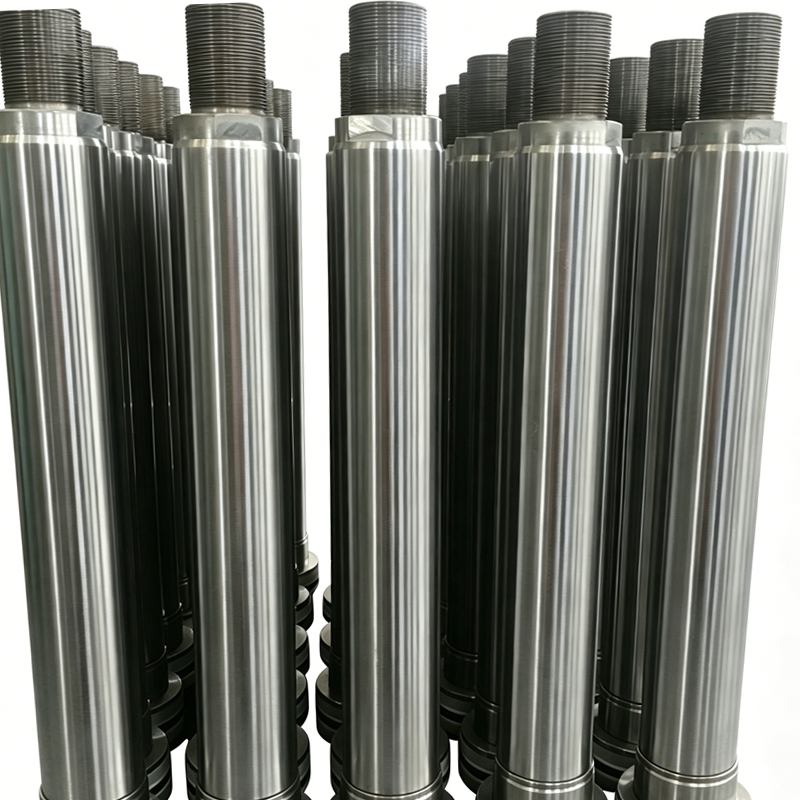
45# is a medium-carbon steel. 40Cr is an alloy steel that adds chromium, which raises hardenability — the depth and uniformity of hardness a grade can achieve through a given quenching cycle. In practical terms, a chromium-bearing grade responds more consistently to hardening and tempering, so the hardened case under the chrome is less sensitive to section size and to variation in the induction cycle.
Where does that difference show up? It shows up where the rod is not simply sliding in clean oil. Side load from a misaligned linkage, impact from a roll-mill duty cycle, or abrasion from a contaminated fluid all concentrate stress at the rod surface. A grade with more hardenability margin tolerates that concentration better before the case softens and the chrome begins to break down. Where the rod runs concentrically, at moderate load, with filtration doing its job, the extra margin buys little.
Both grades are documented as acceptable SB-Y1 rod materials. No comparative wear-test result between 45# and 40Cr rods is published in the source documentation, so any claim that one grade lasts a specific percentage longer would be unsupported. The decision should be made on duty severity and consequence of downtime, not on a wear number that does not exist.
Corrosion behaviour: chrome layer, grease and the stainless alternative
Corrosion protection on both grades comes from the same three elements: the hardened substrate, the 30–50 micron hard chrome layer, and the anti-rust grease applied before shipment. Rod corrosion is documented as a risk where the environment is corrosive or where surface treatment is insufficient, which means the chrome layer and the pre-shipment protection are the controlling variables, not the base grade alone.
This is where buyers should be precise about what they are buying. Upgrading from 45# to 40Cr does not convert a cylinder into a marine-grade unit. Where corrosion, not wear, is the dominant risk — port and offshore duty, washdown, humid storage — the documented alternative is stainless steel: SUS 304 or SUS 316 rod material, which is listed in the SB-piston rod specification alongside 45#, 40Cr and 42CrMo4, and which is intended for marine and offshore as well as construction, mining and hydraulic machinery applications.
Prevention is documented as a combination of heat treatment, induction hardening, hard-chrome plating, grinding and polishing, with straightness, roundness and surface quality inspected and anti-rust grease applied before shipment. That sequence is the actual corrosion-control programme; the grade choice sits underneath it.
Seals, pressure and bore: how the rod decision interacts with 16 MPa and 25 MPa
The SB-Y1 standard sealing system is step seals, Glyd rings and O-rings. Those seal types tolerate a defined band of rod surface finish and straightness. Because the specification holds straightness to 0.015/1000 mm and finish to Ra 0.15–0.2 μm on both grades, the seal interface is equivalent at delivery. The difference emerges over time: a rod whose case softens or whose chrome is breached will roughen locally, and a roughened rod damages the step seal and the Glyd ring on every subsequent stroke.
Pressure rating changes the consequence of that wear. At the 16 MPa nominal rating the rod and gland combination is working with margin, and a 45# rod with correct hardening and chrome is a reasonable specification. At the 25 MPa reinforced rating, the same geometry carries higher surface stress and generates more heat at the gland, so the case margin matters more — which is why heavy press, continuous caster and roughing mill duties are the natural home of the 40Cr option.
Bore size works in the same direction. Across the 40 mm to 320 mm bore range the rod diameter scales with the load, and stroke length is customised on load stability and buckling resistance. Long strokes with large bores increase the bending moment the rod must resist, and ISO/TS 13725:2021 provides the buckling evaluation method for exactly this case. A rod that is adequate at short stroke and small bore is not automatically adequate at long stroke and large bore, even at the same pressure.
Writing the rod requirement into the purchase unit
The purchase unit for a hydraulic cylinder is the cylinder, not the bar stock. That distinction matters because the requirement that prevents rod wear and corrosion is a set of interacting values: grade, hardening hardness, chrome thickness, straightness, surface roughness, rod diameter and the anti-rust protection applied before shipment. Write them together on the cylinder specification, and state the pressure rating the cylinder will actually see.
A usable purchase-unit statement reads: rod material 45# carbon steel (or 40Cr alloy steel), induction hardened to HRC 50–55, hard chrome plated 0.03–0.05 mm, straightness 0.015/1000 mm, surface roughness Ra 0.15–0.2 μm, straightness, roundness and surface quality inspected, anti-rust grease applied before shipment, for a cylinder rated 16 MPa nominal or 25 MPa reinforced. Anything shorter leaves the surface condition to assumption.
Step-by-Step: Specifying Rod Material on an SB-Y1 Purchase Unit
Six steps turn the material question into a verifiable order line.
- Fix the pressure rating first. Decide whether the cylinder runs at the 16 MPa nominal rating or the 25 MPa reinforced version. The rod grade discussion is meaningless until this is settled, because the reinforced rating is the main trigger for 40Cr.
- Define the duty, not just the application name. State whether the rod sees continuous cyclic load, impact, side load or pivoting motion. A trunnion-mounted cylinder driving a linkage behaves differently from a flange-mounted cylinder in a rigid frame, even in the same plant.
- Confirm bore, rod diameter and stroke. SB-Y1 covers bores from 40 mm to 320 mm with custom stroke based on load stability and buckling resistance. Documented steel-mill supply has included 320 mm bore, 220 mm rod and 4630 mm stroke, so the long-stroke, large-rod end of the range is a real configuration, not a theoretical one.
- State the surface requirement explicitly. Grade plus hardening plus chrome plus straightness plus roughness, in one line. This is the clause that makes 45# and 40Cr comparable on delivery and auditable later.
- Decide the corrosion strategy separately. If the environment is corrosive, choose between the chrome-and-grease route on 45# or 40Cr and the stainless route using SUS 304 or SUS 316. Do not treat a grade upgrade as a corrosion upgrade.
- Verify the manufacturer's documentation trail. Ask for the material grade, the hardness values, the chrome thickness and the inspection record against the standard you name. When comparing China hydraulic cylinder manufacturers, this documentation set distinguishes a supplier that controls the rod process from one that only quotes a grade name.
Wuxi Shibang Machinery Manufacturer Co., Ltd. supports this step with a documented capability base: a facility of more than 7,000 m², more than 120 staff, and an R&D team of 8 technical staff including 2 senior engineers and 5 engineers. The company provides OEM/ODM services, warranty service and an after-sales system, and exports account for 30–40% of total sales, with major markets in Europe, the Americas and Southeast Asia and site-listed exports including Russia, Romania, Morocco, Thailand and Germany.
Use Cases: Where the Choice Is Made for You
Steel rolling mills and continuous casters. Roll-mill lifting, balancing, following, turning and push-pull motion combine long stroke with cyclic heavy load. Documented projects include the Jinan Iron and Steel 4300 mm roughing mill and the Shandong Fulun Iron and Steel 1000 mm hot-strip mill, with custom dimensions up to 320 mm bore, 220 mm rod and 4630 mm stroke across the documented supply. In this duty the rod is exposed to impact and to contaminated fluid, which is the case for the 40Cr option with a verified hardened case.
Mining machinery. Mining duty adds particulate contamination and vibration to the load case. Here the surface finish and the integrity of the chrome layer do as much work as the base grade, and the SB-Y1 is documented for mining machinery applications alongside metallurgical service.
Heavy hydraulic presses and injection molding machines. Press duty is characterised by high force at controlled speed. The rigid mounting variants — square or rectangular flange at head, with multi-point rigid connection designed for heavy equipment frames — suit this load path, and the reinforced 25 MPa rating is the relevant specification point.
Port, marine and offshore handling. The Dammam Port RTG crane hydraulic cylinder project called for high load capacity, fatigue resistance, corrosion protection and reliable operation in a demanding port environment. Where corrosion rather than wear dominates, the stainless rod option is the documented answer; where load dominates, 40Cr with a full chrome layer and pre-shipment anti-rust grease is the appropriate specification.
Dam gate openers and engineering machinery. These applications combine outdoor exposure with intermittent duty. The rod spends long periods static, which makes the pre-shipment anti-rust grease and the chrome layer the deciding protection, and makes storage conditions part of the specification.
Comparison Table: 45# vs 40Cr Piston Rod on the SB-Y1 Series
| Selection factor | 45# carbon steel rod | 40Cr alloy steel rod |
|---|---|---|
| Material character | Medium-carbon steel | Alloy steel with chromium addition |
| Listed as SB-Y1 piston rod option | Yes | Yes |
| Hardening on SB-Y1 rod | Induction hardened, hard chrome plated, HRC 50+ | Induction hardened, hard chrome plated, HRC 50+ |
| Risk-control hardness specification | Induction hardened to HRC 50–55 | Induction hardened to HRC 50–55 |
| Quench and temper values (SB-piston rod) | Quenching HRC 50–60; tempering HB 220–260 | Quenching HRC 50–60; tempering HB 220–260 |
| Hard chrome layer | 30–50 microns (0.03–0.05 mm) | 30–50 microns (0.03–0.05 mm) |
| Straightness and surface finish | 0.015/1000 mm; Ra 0.15–0.2 μm | 0.015/1000 mm; Ra 0.15–0.2 μm |
| Corrosion protection before shipment | Hard chrome plus anti-rust grease | Hard chrome plus anti-rust grease |
| Hardenability margin | Lower; case depends on the induction cycle | Higher; chromium improves response to hardening and tempering |
| Typical duty fit | 16 MPa nominal, aligned load, clean fluid | 25 MPa reinforced, impact, side load, high contact stress |
| Documented substitute for corrosive duty | Stainless steel SUS 304 / SUS 316 rod | Stainless steel SUS 304 / SUS 316 rod |
All values above are taken from the SB-Y1 Series and SB-piston rod documentation. No comparative wear-test result between 45# and 40Cr rods is published in that documentation.
FAQ
Which standards should a 45# or 40Cr piston rod be checked against?
The SB-Y1 Series cylinder is documented as compliant with GB/T 2348-1993 and JB/T 10205-2010, with rods in 45# carbon steel, 40Cr alloy steel or stainless steel, induction hardened and hard chrome plated to HRC 50+. Internationally, ISO 10100:2020 specifies acceptance and function tests for hydraulic fluid power cylinders, and ISO/TS 13725:2021 provides the buckling-load evaluation method for single- and double-acting cylinders conforming to ISO 6020, ISO 6022 and ISO 10762. Name the standard in the purchase order and request the inspection record against it, rather than accepting a grade name alone.
Can rod diameter and length go beyond the standard SB-Y1 bore range?
Yes, within documented limits. SB-Y1 bore sizes run from 40 mm to 320 mm with stroke customised according to load stability and buckling resistance, and the SB-piston rod item covers diameters from Φ22 mm to Φ1200 mm with length up to 10 m. Documented steel-mill supply has included a 320 mm bore, 220 mm rod and 4630 mm stroke configuration. Non-standard and custom cylinder requirements are handled through OEM/ODM services.
Is 40Cr mandatory for the 25 MPa reinforced version?
The documentation lists both 45# carbon steel and 40Cr alloy steel as SB-Y1 rod materials and states the reinforced version reaches 25 MPa, but it does not state that one grade is mandatory at that rating. The reasonable engineering rule is to specify 40Cr where the reinforced rating is combined with impact, side load, long stroke or large bore, and to accept 45# where the cylinder runs at 16 MPa nominal with good alignment and clean fluid. Both routes require the same induction hardening and chrome verification.
What drives the cost difference between the two rod grades?
No prices are published for either grade, but the cost structure is visible in the specification. Alloy steel generally carries a higher material cost than plain carbon steel of the same size. Both grades then pass through the same value-adding steps: heat treatment, induction hardening, hard chrome plating at 0.03–0.05 mm, grinding and polishing, straightness, roundness and surface inspection, and anti-rust greasing before shipment. Diameter, length, straightness class, roughness requirement and inspection scope move the cost more than the grade label in many cases, and a stainless SUS 304 or SUS 316 rod is a separate upgrade again.
What information is needed to quote and validate a piston rod specification?
Send the bore size, stroke, mounting type, seal type and mounting dimensions, because bore, stroke, seal type and flange dimensions are the values defined in the cylinder specification for drawing verification. Add the operating pressure — 16 MPa nominal or 25 MPa reinforced — the duty description, and the environment, so the corrosion strategy can be separated from the wear strategy. A validated order then carries the grade, hardness, chrome thickness, straightness and roughness as one specification block. For a technical review of a specific rod requirement, contact Wuxi Shibang Machinery Manufacturer Co., Ltd. at shellpponhydraulic.com or email info@wxsbjx.com.
Conclusion: Decide on Duty, Then Verify on Paper
45# carbon steel and 40Cr alloy steel are not competing answers to the same question. They are two positions on a margin scale. If the SB-Y1 cylinder runs at 16 MPa nominal, is well aligned, sees clean fluid and carries a properly hardened and chrome plated rod, 45# carbon steel meets the requirement. If the cylinder runs at 25 MPa reinforced, absorbs impact, carries side load, or works in metallurgical, mining or press duty where a rod failure stops a line, 40Cr alloy steel buys hardenability margin that the lower grade cannot offer.
What does not change between the two is the surface specification. Straightness of 0.015/1000 mm, roughness of Ra 0.15–0.2 μm, a chrome layer of 30–50 microns and anti-rust grease before shipment are the values that protect the step seals, Glyd rings and O-rings — and those values are only enforceable if they are written on the purchase unit. Specify the grade for the duty, and specify the surface for the seals.
Specify Your Rod Material on the Next Cylinder Order
Send your bore, stroke, mounting type, pressure rating and duty description, and Wuxi Shibang Machinery Manufacturer Co., Ltd. will match the rod grade, hardening and chrome specification to your application. OEM/ODM services, warranty service and an after-sales system are available.
Website: https://www.shellpponhydraulic.com/
Email: info@wxsbjx.com | Tel: +86 510-85596218 | WhatsApp: +86 139-6170-4590
Mobile: +86 139-1238-0800 / +86 139-6170-4590
Address: No. 7 Hengtong Road, Yangshan Industrial Park, Huishan District, Wuxi City, China
Download the shellppon hydraulic cylinder brochure (PDF)
Have Questions or Need More Details?
Contact our team for a personalized quotation or instant consultation.
Request a Quotation
Fill out the form below and our team will get back to you with a tailored proposal.
WhatsApp Direct Chat
Prefer to chat in real-time? Message us on WhatsApp for instant assistance & quick answers.
- Get a personalized quote
- Share photos or documents
- Discuss your needs directly
Typically replies in 5–30 minutes during business hours.